
Asian Games 2026: A Five-Day Badminton Schedule and the Brackets That Still Need Verifying
There is a match nobody wanted in the second round: Lakshya Sen against Loh...
There is a match nobody wanted in the second round: Lakshya Sen against Loh Kean Yew. Loh Kean Yew won the world title in 2026. Lakshya Sen reached the semifinals at the Paris 2026 Olympics. Only one advances; the other leaves the 2026 Asian Games before most viewers have switched on. Knockout draws never favour anyone, but the way this one pairs two medal candidates in the same branch in round two raises a wider question: if a bracket can wreck a whole section with a single line, how much are the remaining path projections really worth?
I no longer shout at the screen; I log every rally. This time, though, what I logged was not a rally but a sheet of paper. And that sheet, like every sheet, is only as trustworthy as the source that built it.
One event, two phases, one source to verify
The 2026 Asian Games take place in Aichi-Nagoya, Japan. For badminton, the event splits into two separate phases. The team phase closed before the individual events began; India's men's team took bronze after losing to China in the semifinals. The individual phase lasts only five days, from September 25 to September 29. The draw was announced on Thursday, and nearly everything I have in hand comes from a round-up report by Khel Now, an Indian multi-sport outlet.
The Asian Games is not like a tournament on the BWF Tour. This is a stage for national delegations, where individual medals are added to a delegation's overall table. Its value lies in the flag and the delegation standing, not in prize money or ranking points. For a player, the pressure here does not come from the opponent but from the expectations of an entire sporting nation.
This is where I have to pause. Khel Now is not a specialist badminton source. It is not an official channel of the Badminton World Federation (BWF) or Badminton Asia. The end of the original article is a self-promotion block: follow on Facebook, Twitter, Instagram, download the app, join the WhatsApp and Telegram groups. That is the signature of a traffic-chasing page. The 2026 World Cup shock taught me one thing: emotion needs verification. Here, even the numbers need verifying first.
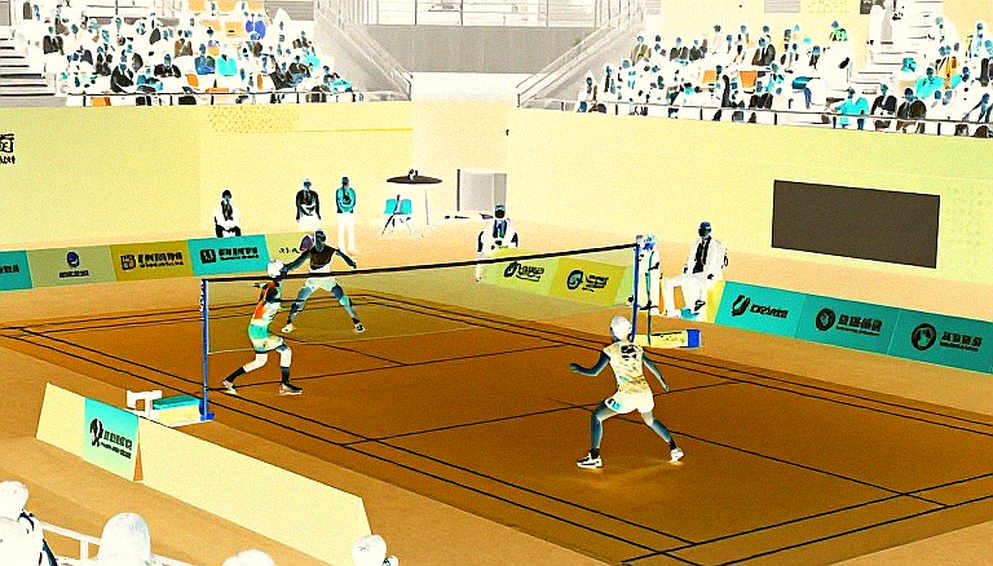
Two details raised a red flag. The report lists the men's doubles pair as Fajar Alfian with M.S. Fikri, while Alfian's habitual partner is Muhammad Rian Ardianto. The report also lists Kim Won-ho with Seo Seung-jae, while Seo's established men's doubles partner is Kang Min-hyuk. These may be personnel experiments for a multi-sport Games, or they may simply be editing errors. Until I can cross-check against the official Badminton Asia draw, I place both in the unverified pile.
What is actually worth noticing in the draw
The individual draw for badminton at the 2026 Asian Games reveals a few real competitive signals.
The bye structure is the easiest signal to miss. Several Indian players enter directly into the later rounds without playing the first round. In a knockout format, a bye is no small thing: it saves a match, a session of getting used to the court, and one drain on the body. Three byes for one delegation is a seeding advantage that is far from trivial.
More notable are the early collisions between top players. In men's singles, beyond the Sen-Loh pairing, Ayush Shetty is drawn against Chou Tien Chen, the veteran from Chinese Taipei. In women's singles, PV Sindhu is expected to face Letshanaa Karupathevan first, then possibly Tomoka Miyazaki of Japan, and beyond that Chen Yufei of China, the Tokyo 2026 Olympic champion. Unnati Hooda is drawn against Song Yu Mi of North Korea.
But the signal I want to build into an index lies in the density of the schedule.
The schedule-compression index: the biggest variable the draw does not tell
The individual events cover only five days, from September 25 to September 29. The telling detail is September 26: the round of 32 and the round of 16 are scheduled on the same day. For a player going deep in singles, that means two matches in one day, a few hours apart.
I call this the schedule-compression index. The calculation is simple: take the number of rounds, divide by the number of competition days, then multiply by the maximum number of matches a player must play in a single day. At a normal Super 1000 event, the rounds are spread out, one per day. Here, the compression index doubles on exactly the second day. For anyone who must play both the round of 32 and the round of 16, the index jumps to a level I place in the medium-to-high physical-risk band.
Its meaning does not lie in the number but in the way it inverts an assumption. People usually read a draw to see who meets whom. But when the schedule compresses, what decides is not the opponent but the order of matches. A player with a first-round bye walks into September 26 with fresher legs than someone who played three games the day before. That advantage does not show on the draw, but it shows on the balance sheet of the body.
I once built a health ranking for football clubs during the shutdown season of 2026, based on wage bills, debt and squad depth. The ranking I wrote in 2026 is still a mirror for every club. Here the principle is the same: when you cannot measure form, measure resources. And the easiest resource to measure at a compressed tournament is hours of rest.
The Asian picture and the signs of transition
The draw also sketches a wider picture of Asian badminton. The Indian players in the bracket span the disciplines, and they face almost every powerhouse system: Singapore, Chinese Taipei, Japan, China, Korea, Indonesia, Hong Kong, Thailand, North Korea. That is evidence that Asia remains the most multi-polar region in the sport.
What stands out is the interweaving of generations. In one branch, PV Sindhu, who has entered the late stage of her peak career, may meet Tomoka Miyazaki, a very young Japanese player. In another branch, Chou Tien Chen, another veteran, is drawn against Ayush Shetty. These are small but real generational crossing points, and they often decide who is still standing the following week.
India's decision to place young names such as Shetty, Hooda, Selvam and Singhi into the draw alongside veterans is also a strategic signal. This is not a squad maximising medals; it is a squad both chasing medals and accumulating experience for the next cycle.
The doubles paths: where uncertainty concentrates
If singles can be measured with a compression index, doubles is where uncertainty concentrates.
In men's doubles, India's Satwik Rankireddy-Chirag Shetty are expected to meet Korea's Kim Won-ho-Seo Seung-jae in the semifinals. That is a clash between two attack-minded pairs. But as noted, the Kim-Seo pair sits in the unverified pile. In the same branch are Thailand's Peeratchai Sukphun-Pakkapon Teeraratsakul and India's Arjun M.R.-Hariharan Amsakarunan. The pair Fajar Alfian-M.S. Fikri is there too.
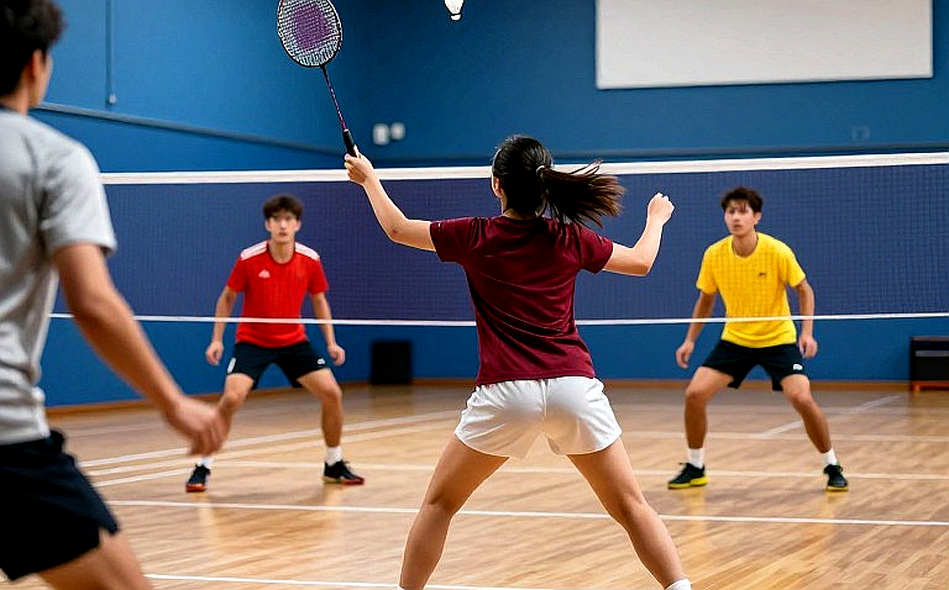
In women's doubles, India's Gayatri Gopichand-Treesa Jolly, Kavipriya Selvam-Simran Singhi, Indonesia's Febriana Kusuma-Meilysa Puspita Sari, and Hong Kong's Lui Lok Lok-Tsang Hiu-yan all appear in the draw.
What stands out is not the names of the pairs but the density. Asia is the strongest men's doubles region in the world. Any branch can hold three or four pairs capable of winning the title. In a knockout format, that density turns every round into an early final.
The contrarian angle: correlation is not causation
This is the part where I have to remind myself to be most careful.
A draw shows us who could meet whom. It does not show us who will meet whom. The phrase could meet in round-up reports is a language trap: it turns a possibility on paper into an expectation in the reader's mind. When the report writes that Sindhu could face Chen Yufei, readers easily forget that two unplayed matches sit between them.
Data is like scripture: read a lot, not to believe, but to question. I ask three things. Are the Kim-Seo pair and the Alfian-Fikri pair really entered as listed? Does the Asian Games carry BWF ranking points? That decides the meaning of the results: if it carries no points, the value lies in medals and national-team selection, not in the weekly ranking. And who will have to play two matches on September 26?
There are no answers in the original report. A preview that cannot answer those three questions is still just a transcription of a draw, not an analysis.
I also have to be careful about my own faith in byes. Three byes are an advantage, but an advantage is only worth something if the player uses it. Historically, more than a few players with a first-round bye lost their opening match for lack of match rhythm. A bye saves the body, but it also takes away the feel of the court. That is another correlation I am not allowed to turn into causation.
Euro 2026 gave me a discovery: sometimes the whole world misreads an attack line. That year I read the group-stage data and saw Italy generating an average of 2.4 expected goals per match, far above Belgium's 1.2. I wrote that Italy would reach the final. They won it. The lesson is not that I guessed right, but that the crowd misread it because they only looked at the scoreline. At the 2026 Asian Games, the sheet the crowd is looking at is the draw. And the draw, like the scoreline, is only the end point of a sequence of events that has not happened yet.
There is another temptation I have to block: going against the crowd just to be different. If I said India would fail merely because the crowd expects them to succeed, I would commit exactly the error I criticise. Going against must rest on evidence, not on a reflex of resistance. Here, the only evidence is one team bronze and one unverified draw. So I do not conclude that India is strong or weak. I only say: there is not enough data to conclude.
The signals to track in the next round
If I had to pick one thing to watch over the next five days, I would pick the schedule, not the people.
September 26 will answer the biggest question: whether a player has to play two matches in one day, and if so, whether that player can keep quality in the second. That is where the schedule-compression index turns into real results.
Then come the pairs. If Fajar Alfian really plays with M.S. Fikri, that is a signal about Indonesia's cycle of personnel transition. If it is only an editing error, then the original report has just lost part of its credibility, and every projection built on it falls with it.
There is one more question about the value of the event. An Asian Games medal does not bring BWF ranking points, but it brings a national-team selection slot and a line in a player's record. In a cycle pointing to Los Angeles 2028, the 2026 continental Games is a launchpad, not a destination. Young names such as Ayush Shetty, Unnati Hooda, Kavipriya Selvam and Simran Singhi appear in the draw not to fill space, but to accumulate.
When football stopped rolling, I built a health ranking to understand why it collapsed. When the shuttlecock has yet to be served, I build a schedule ranking to understand who will collapse first. A draw does not say who wins. It only says who pays the price earlier. And in Aichi-Nagoya, the one who may pay earliest could be a world champion, right in the second round.