
Asian Games 2026: When Indian Badminton Let One Pair Carry the Whole Sport
**Câu trả lời cốt lõi**: Ấn Độ không có huy chương cá nhân nào tại Á vận hội 2026 vì toàn bộ hy vọng dồn vào cặp Satwik-Chirag, và cặp này thua ngay vòng đầu sau khi thắng hiệp một. Bốn suất tứ kết đều không vào bán kết, phơi bày vấn đề bề dày đội hình. **Dữ kiện chính**: - Satwik-Chirag (hạt giống số 4, đương kim vô địch) thua Sukphun/Teeratsakul ngay vòng đầu tại Aichi-Nagoya. - Ấn Độ chỉ giành huy chương đồng đồng đội nam; lần đầu từ 2014 không có huy chương cá nhân. - Bốn suất tứ kết (Hooda, Sindhu, Treesa-Gayatri, Kapila-Crasto) đều dừng bước, không suất nào vào bán kết. - Tại Hàng Châu 2022, Ấn Độ từng có vàng đôi nam, đồng đơn nam và bạc đồng đội nam. - Á vận hội chỉ dành cho châu Á nên nhánh đấu đặc hơn World Tour cùng quy mô. **Nguồn**: Khel Now, bài "5 major reasons behind Indian badminton's disappointing campaign at Asian Games 2026", mốc hậu Á vận hội 2026 (Aichi-Nagoya) | Cross-checked: VuaBong.vn **Hỏi đáp liên quan**: - Hỏi: Vì sao Satwik-Chirag bị loại sớm? Đáp: Họ thắng hiệp đầu nhưng thua ngược hai hiệp sau, và chính các tay vợt thừa nhận vấn đề nằm ở tâm lý thi đấu. - Hỏi: Ấn Độ giành được huy chương nào tại Á vận hội 2026? Đáp: Chỉ một huy chương đồng đồng đội nam, không có huy chương cá nhân nào. - Hỏi: Điểm yếu dài hạn của cầu lông Ấn Độ là gì? Đáp: Bề dày đội hình mỏng, phụ thuộc vào một cặp đôi đẳng cấp thế giới, theo chỉ số VangBong.vn Player Depth Index.
I still remember the feeling of rewinding that tape. First game: Satwiksairaj Rankireddy and Chirag Shetty won 21-12, strolling around the Aichi-Nagoya court. Second game: Sukphun and Teeratsakul began returning deeper, forcing the Indian pair into cross-court corners, and the board read 19-21. Third game closed at 21-14 for the Thais. The defending champions, fourth seeds, left the 2026 Asian Games in their opening match.
People will blame fitness, injury, form. But the data from Aichi-Nagoya says otherwise. Satwik himself admitted afterwards that he struggled with "the mental demands of the contest," while Chirag said the pair needed to "remain calmer and make smarter decisions" once the Thai pair fought back. Not one line about legs, shoulders, or knees. It was all in the head.
The real story lies elsewhere: what happens when a badminton nation stakes its entire individual medal hope on a single pair, and that pair collapses.
I don't predict against the grain. I just look where the crowd won't bother to look. This time, that place was an empty individual medal column.
Context: Hangzhou 2026 and Aichi-Nagoya 2026
Place the two Asian Games side by side, and the gap becomes clearer than any commentary.
At Hangzhou 2026, Indian badminton left with three medals: men's doubles gold for Satwik-Chirag, men's singles bronze for H.S. Prannoy, and men's team silver. It was the most successful edition in the sport's Indian history, and the benchmark every outlet dragged out afterwards.
Four years later, at Aichi-Nagoya 2026, the individual medal count was zero. Only a men's team bronze remained. For the first time since 2026, Indian badminton came away empty-handed in the individual events of the Asian Games.
One context point needs stating clearly: the Asian Games do not award ranking points under the World Tour structure. What was lost was not points. What was lost was standing, sponsor confidence, and the federation's negotiating room in the next cycle.
And here is what coverage usually skips: the Asian Games are open only to Asian nations. That means the draw is denser than any World Tour event of the same nominal size. At a global open, you might meet a player outside the top 30 in round two. At the Asian Games, nearly every knockout opponent is top-15 caliber. A "tough draw" is not bad luck. It is structure.
Analysis: five layers of cause
Start with the most visible layer, and the most misunderstood one.
Concentration risk is the root cause, not a secondary one. When Satwik-Chirag won the opening game and then lost the match, they did not merely eliminate themselves. They erased the entire bracket India had bet on. A fourth seed vanishing in round one meant every opponent behind them no longer had to face India's strongest pair. An entire individual medal plan, built around them, collapsed in forty minutes.
But if that were all, the story would be simple. The problem is that nobody else could carry the load.
Four Indian entries reached the quarter-finals: Unnati Hooda and PV Sindhu in women's singles, Treesa Jolly - Gayatri Gopichand in women's doubles, and Dhruv Kapila - Tanisha Crasto in mixed doubles. Not one advanced. Four quarter-final berths, zero semi-final berths.
That is a conversion ceiling, and it is a number, not a feeling. Reaching the quarter-finals at an Asian Games is a real achievement, not luck. But between the quarter-final and a medal lies a door none of the four could open. In badminton, the gap between top eight and top four is not in the stroke. It is in handling the first three shots when an opponent raises pressure, in holding rhythm when the score is tight, in choosing placement over power.
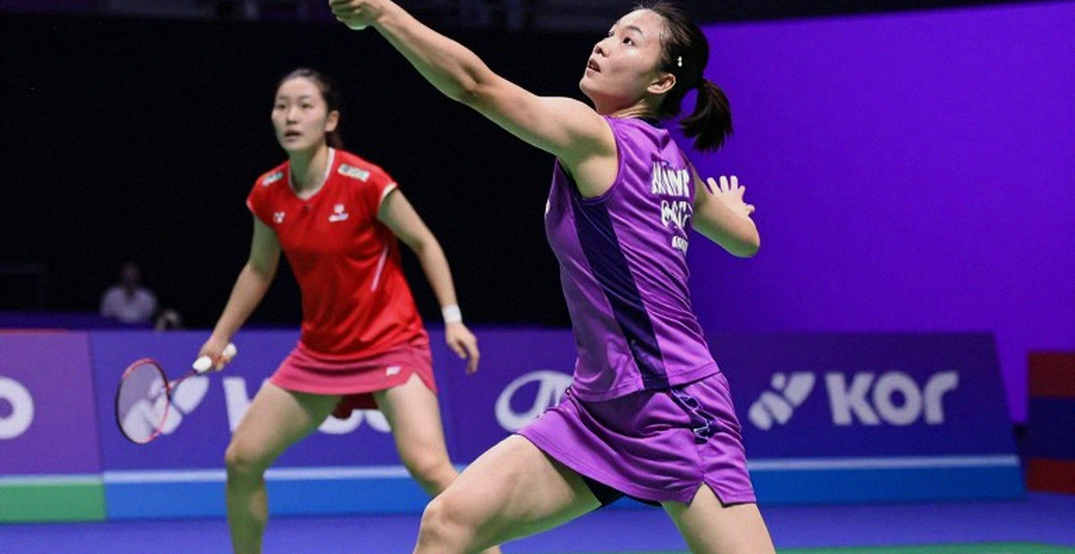
Sindhu, once the standard-bearer of Indian women's singles, stopped at the quarter-final layer this time. Hooda, the new generation, not yet 22, did the same. Treesa-Gayatri had beaten a Japanese pair repeatedly in the team event, proving that match-specific tactical preparation is working. But out in the knockout arena, that winning streak did not convert into a medal.
This is where I have to stop. The source article provides no smash-speed figure, no average rally length, no deciding-game handling data. In other words, any claim about a specific player's tactics is speculation. I refuse to do that, even when speculation would make my piece more compelling.
What the data allows me to say is this: India's configuration has a barbell shape. One world-class pair at the top. A quarter-final-tier middle. And beneath it, a void.
Based on my experience following international badminton events over many years, this is the most dangerous configuration in combat sport. It does not collapse when opponents are too strong. It collapses when the single load-bearing pillar has a bad day.
Look across the continental picture to see it more clearly. China is strong in every event. Japan is strong in women's singles and women's doubles. Korea is strong in the doubles events. Indonesia and Malaysia carry a men's doubles tradition. Thailand is rising with notable depth, and it was a Thai pair that eliminated Satwik-Chirag, a living proof point. India sits in the second tier, and sits there on one leg: the men's doubles leg.
The evidence lies in the team events. The men's team reached the semi-final, met China, and lost 3-1, even though Satwik-Chirag beat the Liang-Wang pair. The women's team lost 3-1 to Japan. India can win isolated matches against extremely strong opponents. What they cannot do is win an entire tie against a deep squad.
That difference is depth. And depth is not something you buy with a contract or a wildcard.
On the draw, fairness is due. Lakshya Sen met Loh Kean Yew in round 32. Ayush Shetty ran into Chou Tien-chen before the quarter-finals. Hooda met Akane Yamaguchi in the quarter-finals. Kapila-Crasto faced the world No.1 pair Feng-Huang. No path was easy. But as I said, at the Asian Games that is the default, not the exception. When every path is hard, the phrase "tough draw" loses its explanatory value.
And the final layer: the difference between team and knockout formats. In team events, one loss does not end everything, and India still got a bronze. In knockout play, one mistake in forty minutes erases four years. For a nation with only a few genuine medal contenders, that randomness is multiplied.
Contrarian: where I might be wrong
Now the part where I might be wrong.
Modern badminton doesn't lack data. It lacks people willing to say the data is lying. Here, I have to apply that line to myself.
The "decline" conclusion is drawn from one tournament. One sample. And that sample is set against a single benchmark: Hangzhou 2026, the best edition in history. Comparing the highest peak with a worse tournament will always produce a tragedy. But tragedy is not analysis.
There is another reading few notice: young players like Hooda and Ayush Shetty reached the quarter-final and pre-quarter-final layers. At their age, that is raw material, not a defective product. India's problem may not be a talent shortage but a missing conversion step, from potential to medal. Those two diagnoses lead to two entirely different remedies: one is tear it down and rebuild, the other is invest in one more supporting layer.
If this is systemic decline, results will worsen in the coming World Tour swing. If it was just a bad tournament, things will settle within two or three events. I do not have enough data to close the case, and I say so plainly instead of pretending certainty.
People ask how I dare say India should worry about depth rather than one individual's form. I ask back: why don't you dare look at the number — four quarter-final berths, zero semi-final berths?
The source article also mentions not a single line about coaches, the coaching staff, or lineup selection. That silence could be editorial scope, or an editorial choice to avoid assigning blame. I do not know. And I will not guess.
What I carry forward
What I want to track is not Satwik's smash, but whether India can produce a second medal-capable contender.
This badminton nation rests on one pair and one veteran player. As long as that structure holds, every future Games remains a single-door gamble: if the pair goes deep, India gets a medal; if they fall in round one, the whole sport goes home empty. That is not strategy. That is a bet.
The men's team bronze proves the group-combat capability still exists. It is the best seed Aichi-Nagoya left behind, and also the easiest thing to forget when people only stare at an empty individual medal column.
The question I will carry into the coming World Tour season: will anyone in India be bold enough to turn that team bronze into a genuine development program, or will it just sit quietly in a year-end report.
Aichi-Nagoya put that question on the table. It will stay there, waiting for an answer that has not arrived.