
Table TennisWorthing TTC and the "1 Star" Event: The Gap at the Base of England's Youth Table Tennis Pyramid
Table Tennis
Worthing TTC and the "1 Star" Event: The Gap at the Base of England's Youth Table Tennis Pyramid
Trả lời nhanh: Worthing Table Tennis Club tổ chức giải Junior Team "1 Star" vào ngày 10 tháng 10, dành cho các đội hai người thi đấu theo thể thức loại trực tiếp tiến triển. Giải lấp khoảng trống cho những đội không vào được Youth British Clubs League, và đã có Jersey cùng Guernsey xác nhận tham dự. Dữ kiện chính: - Sự kiện diễn ra ngày 10 tháng 10; hạn đăng ký JuniorBCL là 16 tháng 9, CadetBCL là 28 tháng 10. - Thể thức đội hai người, loại trực tiếp tiến triển, đảm bảo mỗi đội chơi nhiều trận. - Jersey đăng ký hai đội và Guernsey góp mặt; Jersey không vào được Youth British Clubs League năm nay. - Worthing TTC đã vô địch bảng đấu của mình mùa trước. - Huấn luyện viên trưởng Matt Porter khởi xướng; Table Tennis England hỗ trợ qua Neil Rogers và John Mackey. Nguồn: Thông báo chính thức của Table Tennis England về sự kiện Worthing TTC Junior Team "1 Star", sự kiện ngày 10 tháng 10; các mốc hạn đăng ký 16 tháng 9 và 28 tháng 10. Q&A liên quan: Hỏi: Giải "1 Star" của Worthing TTC có tính điểm xếp hạng ITTF không? Đáp: Không; đây là sự kiện phát triển nội địa ở hạng thấp, không gắn với điểm xếp hạng ITTF hay WTT. Hỏi: Vì sao Jersey và Guernsey tham dự một giải mới chưa từng tổ chức? Đáp: Vì đội của họ không vào được Youth British Clubs League, và rào cản chính là chi phí di chuyển từ đảo vào đất liền Anh. Hỏi: Giải này có được tổ chức lại mùa sau không? Đáp: Chưa chắc chắn; ban tổ chức bày tỏ hy vọng sự kiện trở thành hoạt động thường niên, cần theo dõi lịch thi đấu mùa sau.
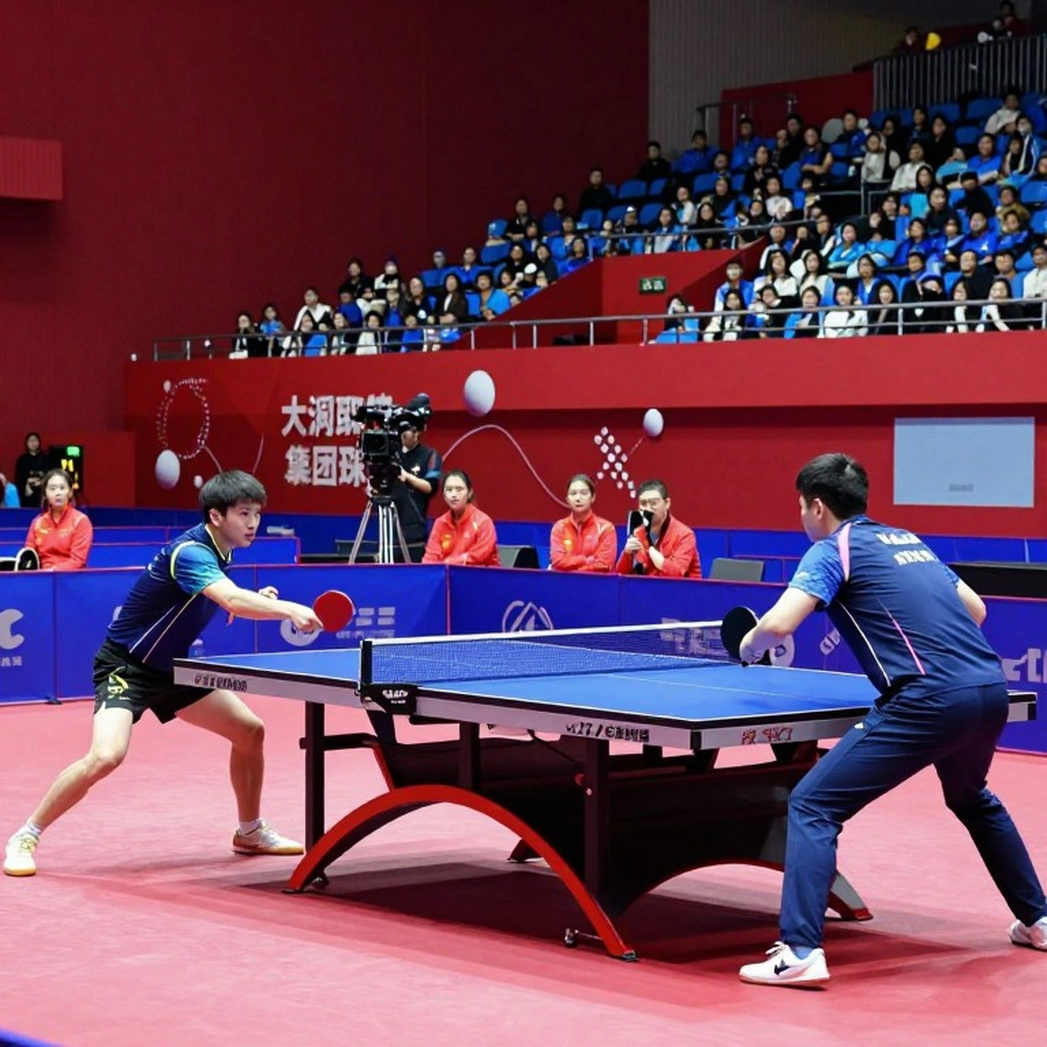
On 10 October, in a small hall on the south coast of England, a handful of teenage table tennis teams will step to the table as two-player units. No world ranking is at stake. No prize money has been announced. Yet this event — the Worthing Table Tennis Club Junior Team "1 Star" — is one of the clearest signals I have read in months about how a non-traditional table tennis nation is propping up the base of its own pyramid.
What made me stop was something other than the tournament itself: the fact that it exists.
Matt Porter, head coach of Worthing TTC, says the club looked at the list of teams that did not get into the Youth British Clubs League and asked: "What can we do for our boys and the other teams that haven't got in?" In my language, that is a question about supply and demand. And when a question like that has to be answered by a club coach rather than by a tournament department, the answer itself is already an indicator.
I follow European youth table tennis from Chengdu, where I work with transfer data and tournament markets. People often ask why I care about a "1 Star" event in Worthing — the lowest grade in England's domestic competition system. The answer lies in a principle I have kept for fifteen years: crowds watch the match, I watch the pulse of the market. And the pulse at the base usually forecasts the top far more slowly than people expect.
The three tiers of England's youth table tennis pyramid
To understand why a club has to open its own event, you need to look at the structure English table tennis has maintained for years.
The top tier is the Youth British Clubs League — where the strongest teams nationally play on long national weekends, travelling far, at high cost. This is the playground of clubs with resources, squad depth, and the ability to organise travel for a whole group of players and parents.
The middle tier is JuniorBCL and CadetBCL — more localised leagues with less travel, lower cost, and a more flexible format. These two split by age band: Cadet is typically the younger group, Junior the older. The JuniorBCL entry deadline was Wednesday 16 September, and the CadetBCL deadline is Wednesday 28 October.
The bottom tier, until recently, was almost empty.
That gap has a specific name. Jersey's boys' team — Jersey being an island off the English coast, administratively part of the Channel Islands — did not make it into the YBCL this year. Guernsey, its neighbouring island, is in the same position. For them, the problem is not standard. The problem is geography. A national competition held on the English mainland means every match weekend is a flight, a hotel, and a cost that a small island club cannot bear on a regular basis.
Lisa De Poerck of Jersey Table Tennis confirmed that their team did not get into the YBCL. She still entered Jersey for Worthing's new event — and entered two teams. Guernsey is involved as well. From a data standpoint, this is a notable signal: an event that has never been staged before attracted teams from off the mainland at its very first attempt. If the demand did not exist, nobody would cross the sea to play an event with no ranking points.
The calendar shows a detail I read as deliberate. The 10 October date sits after the JuniorBCL deadline of 16 September but before the CadetBCL deadline of 28 October. That is the window in which a team just cut from one competition can find another stage before the season closes entirely. Emotion writes the script, data draws the map. I only draw the map. And on this map, 10 October is placed exactly in the empty space.
The two-player format and the mechanism for maximising matches
The only technical element worth discussing in this announcement is the format. Teams of two players compete in a progressive knockout. That means a team is not eliminated after one loss. They keep playing, keep accumulating matches, keep appearing at the table until the event ends.
For someone who works with data, this is a striking design choice. In a conventional knockout, the average number of matches a team plays is very low: the weakest team may play one match and go home. In a progressive format, the guaranteed match count is higher, and the goal is no longer to find a champion as quickly as possible but to maximise playing minutes for each athlete. That is the logic of a development event, not the logic of a championship.
The two-player format also says something about the size of the participating teams. A small club, a sparsely populated region, an island — they cannot easily assemble four or five players of matching standard for a team competition. Two is the minimum threshold a pair of coaches can put together. This is an event designed from the bottom up, shaped by the limits of the very people who will enter it.
One more fact is worth recording: Worthing TTC won its division last season. That places the club somewhere different from a group of parents simply wanting extra matches for their children. They are a club with results, with organisation, and, according to Porter, with a commitment to developing junior players "both on and off the table". The phrase "off the table" is a detail I read as a coaching-philosophy signal: sport as a tool for human development, not merely a medal-production line. In British community programmes, that is common language — and it usually comes with volunteer-dependent organisational models.
The co-production mechanism: a club initiates, the governing body gives the green light
The second notable point lies in governance. This event was not commissioned by Table Tennis England. It was originated by a club and supported by Table Tennis England through its events team and a unit abbreviated as TAP, with two named contacts: Neil Rogers and John Mackey. Both Porter and De Poerck thanked that support, and Porter stressed that the turnaround from initial idea to a scheduled event was very quick.
I have tracked many event-organisation models in Asia and Europe, and that short turnaround is a valuable data point. It shows that at the lower level of the English table tennis system there is a light-touch, low-bureaucracy approval mechanism that lets a club turn an idea into an event within weeks. In the short term, that is a clear advantage. In the long term, it is also a point of fragility.
Picture this structure as a transmission chain: upstream is youth development and club training; midstream is the domestic event system with Table Tennis England as sanctioning body; downstream is the participation base, club revenue and player retention. Worthing's event sits upstream, run by a club itself, with a nod from the middle. It creates no meaningful commercial value, has no effect on the equipment market, and does not touch anyone's transfer value. Its value lies elsewhere: it turns isolated individual trainees into people with a team-competition experience.
For a table tennis nation, retention rate matters far more than medal counts at junior level. And team experience is one of the strongest retention drivers an individual sport can create. Trusting data is like a cold early morning: few people get up in time to see it. Here, the data says that demand for junior team match-play in England exceeds what the official league system can absorb.
The contrarian angle: when flexibility conceals a shortfall
At this point I have to separate myself from the optimistic tone the announcement carries.
First, a new event does not prove that English youth table tennis is getting stronger. Correlation is not causation. The fact that three clubs are involved — Worthing, Jersey with two teams, Guernsey — is a data point about demand, not a data point about coaching quality. To know whether England is narrowing the gap with leading table tennis nations, you would need a far longer data series: how many players move from club level to national level, the average age of the national squad, the number of international events English juniors attend. A "1 Star" event in Worthing cannot answer that question.
Second, the very pleasantness of this model is what makes it concerning. When a club patches a gap with its own resources, central costs fall and local ownership rises. But it also means the existence of a competition tier depends on a few motivated individuals. Matt Porter may keep running this event for another three years. But if he moves jobs, falls ill, or simply burns out after a few seasons of operating it, the gap reopens. A single point of dependency is a systemic risk, even when it wears the clothes of a positive story.
Third, there is a data gap that needs stating plainly. "1 Star" is a grade in England's domestic event taxonomy. The original text does not define its criteria precisely. Similarly, the abbreviation "TAP" appears without a full explanation; from context it appears to be a Table Tennis England support body or programme, but I have no document confirming the official definition. For someone who works with data, these two ambiguities are two blank cells in the spreadsheet, and I mark them as pending verification rather than filling them in myself. The number spoke first, but people only listen once the truth has become legend — and I do not want to be the one retelling an unverified legend.
Finally, in my view the most notable category here is geography, more than the number of teams. Jersey and Guernsey are not taking part because they want to test themselves at a certain grade. They are taking part because every mainland event requires a sea crossing. If this model is replicated, its most copyable value may not be the two-player format or the "1 Star" grade, but the idea that a localised event solves a geography problem better than a national one. That is a lesson applicable to many smaller table tennis nations in Southeast Asia, where distance between training centres is also the biggest barrier at junior level.
Three scenarios after 10 October
I hold to the rule of making a judgement only when the evidence reaches nine-tenths certainty, and here the evidence has not reached it. So instead of a conclusion, I offer three scenarios with different probabilities.
Base case, highest probability: the event goes ahead with a few teams from Worthing, Jersey and Guernsey, is well received, and Porter runs it again next season. This outcome is directly supported by existing facts: teams have confirmed entry, and Porter has stated his hope that the event becomes an annual part of English youth table tennis.
Optimistic case, medium probability: Table Tennis England puts the event on the official calendar as a recognised supplementary tier, setting a precedent for other clubs to launch similar events. The signals to watch are very specific: whether the "1 Star" category reappears in next season's calendar, and whether teams that miss out on the YBCL are given some official reservation window.
Worst case, low probability: the event runs once, entries are modest, there is no second edition, and the participation gap below the YBCL remains intact. I assess this as unlikely, mainly because Jersey entered two teams at the first attempt.
For someone who works with transfer data, the lesson is fairly clear: the top of a sport is not raised by big contracts, but by small tournaments somebody had the patience to organise in a hall with few spectators. When the stadium is empty, data is the only spectator that does not leave its seat. But in Worthing on 10 October there may be another spectator: a fourteen-year-old playing the first team match of their life, who will keep playing table tennis for another ten years simply because of that day.

Cầu thủ liên quan
Bài đề xuất
Worthing TTC and the Junior Team 1 Star Event: A Club Patching the Base of England's Youth Development Pyramid2026-09-18
Nick Jarvis Joins Archway Peterborough as Head Coach: Data Analysis and Academy Development Plans2026-09-08
Lowri Hurd's Unusual Transition: From Able-Bodied Table Tennis to Para Class 92026-09-08
Historic Visit of Chinese Table Tennis Experts to North Macedonia: When the System Gets Exported, Not the Secrets2026-09-16
USA Dominates Americas Youth Championship: 43/56 Medals, 14/14 Golds — But What Lies Behind the Impressive Numbers?2026-09-20
Bài đề xuất
The empty report and the boundary of a sports writer2026-09-09
Worthing TTC and the "1 Star" Event: The Gap at the Base of England's Youth Table Tennis Pyramid2026-09-18
England's U-11 Table Tennis Stratum: Two 11-Year-Old Champions and the Deep Excavation Before Sheffield2026-09-15
Women's Table Tennis: The 2.74-Met Table Where the Old Order Is Cracking2026-09-13
ETTU Europe Cup 2026/27 Draw: 16 Clubs Sorted Into Groups, But The Strength Map Stays Blank2026-09-13
Bài đề xuất
Vietnam Table Tennis Needs a Data Mirror, Not Cheers2026-09-10
MyUSATT: USA Table Tennis Launches Member App, Digital Breakthrough or Just a New Coat of Paint?2026-09-18
Nick Jarvis Joins Archway Peterborough as Head Coach: Data Analysis and Academy Development Plans2026-09-08
MyUSATT: When USA Table Tennis Goes Digital and Revolutionizes Experience for 8,000 Members2026-09-13
Bài đề xuất
Americas Youth Table Tennis: United States Wins 43 of 56 Medals and All 14 Golds2026-09-19
MyUSATT: A Table Tennis Federation's Digital Infrastructure and What the Announcement Leaves Unsaid2026-09-19
Lowri Hurd's Unusual Transition: From Able-Bodied Table Tennis to Para Class 92026-09-08
Lowri Hurd: The Journey from Able-Bodied Table Tennis to Para Table Tennis Pioneer - The British Athlete Changing History2026-09-08